

How to Measure AI Product Success and Outcomes
Engagement is not success. Learn how to define outcomes for your AI product, track completion rates, and understand why customers fail.
Why Outcomes, Not Engagement
Engagement is the default metric because it is easy to measure. But for AI products, engagement and success are often inversely correlated.
A customer who sends 50 messages might be deeply engaged with a product that works. Or they might be stuck on a basic task, rephrasing their request over and over, growing more frustrated with each attempt. The message count is identical. The experience is opposite.
This is the engagement trap. Teams optimize for what they can measure. When the only visible metric is engagement — messages sent, session duration, return visits — teams optimize for engagement. But engagement metrics reward the wrong behavior in AI products. A customer struggling for 30 minutes generates more "engagement" than a customer who succeeds in 2 minutes.
Outcome measurement is the corrective. It answers the question that actually matters: did the customer accomplish what they came to do? Everything else — turns, sentiment, journey length — is diagnostic. Outcomes are the bottom line.
Types of Outcomes
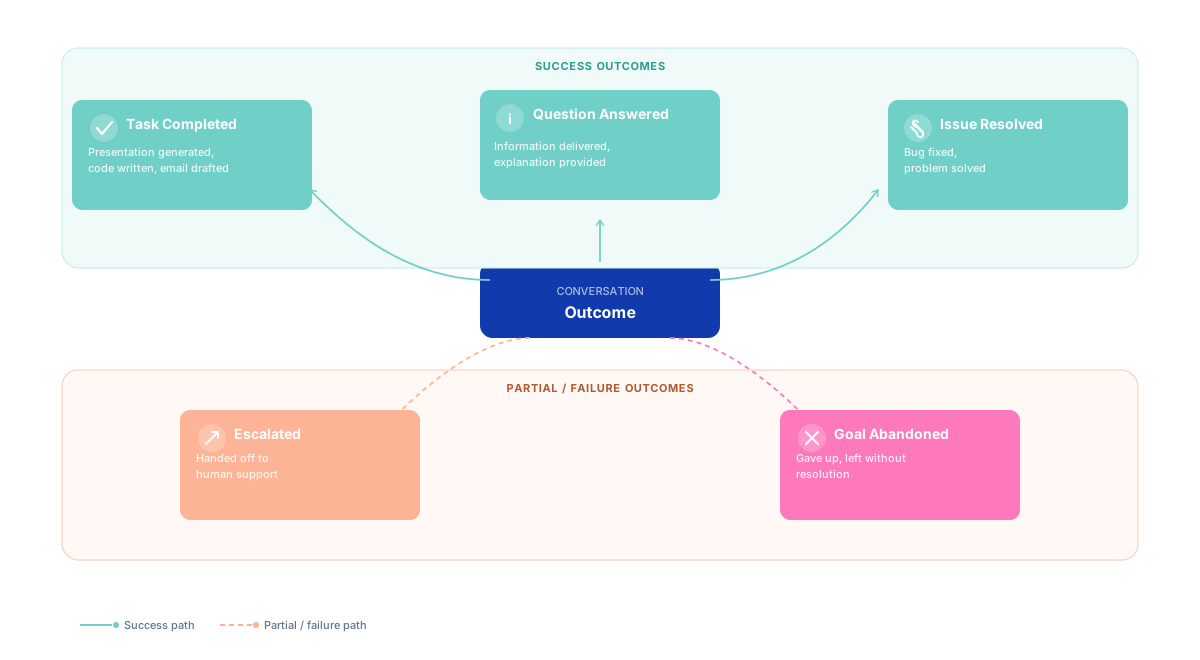
Every AI product should define its outcome types explicitly. Most products have 3-5 relevant outcome types.
Task completed: The customer achieved a specific output. A presentation was generated. Code was written. An email was drafted. A report was produced. This is the primary success metric for generative AI products.
Question answered: The customer received the information they sought. This is the primary success metric for knowledge assistants, support agents, and FAQ bots.
Issue resolved: A problem the customer identified was fixed. This is the primary success metric for AI debugging assistants and support agents handling technical issues.
Goal abandoned: The customer gave up before reaching resolution. They left the conversation without completing their task. This is a failure metric. Understanding why customers abandon is critical for product improvement.
Escalation: The conversation was handed off to a human agent. This is a partial success — the customer's issue is being addressed — but it represents a failure of the AI to resolve independently.
The first step for any product team is to define which of these outcome types apply to their product and establish clear criteria for each. Without explicit definitions, outcome measurement is impossible.
Measuring Outcome Quality
Completion is not the same as satisfaction. A task can be "completed" without being done well.
Consider an AI presentation tool that generates a deck. The task is technically complete — slides were created. But did the customer download the deck? Did they use it? Did they come back to generate another? These downstream behaviors indicate whether the outcome had quality or whether the customer accepted a subpar result and moved on.
Proxy signals for outcome quality include post-outcome actions (download, share, export, deploy), return behavior (did they come back for similar tasks?), refinement requests (did they need many edits after the "completed" output?), and explicit feedback when captured.
Outcome quality is harder to measure than outcome completion, but it distinguishes between customers who got real value and customers who got technically complete but unsatisfying results. The latter group is a churn risk that completion metrics alone will not identify.
Outcome Rates and Patterns
Outcome rates become actionable when segmented.
Success rate by intent type reveals which use cases your product handles well and which it does not. If task completion intent has an 80% success rate but problem resolution intent has a 40% success rate, you know exactly where to focus improvement.
Success rate by customer segment reveals which customers are getting value and which are not. If enterprise accounts have a 70% success rate but SMB accounts have a 45% success rate, the product may have implicit complexity assumptions that smaller teams cannot meet.
Success rate by journey characteristics reveals what predicts success. If conversations with fewer than 10 turns have an 85% success rate while conversations with more than 20 turns have a 30% success rate, journey efficiency is a strong predictor of outcome.
Combining these dimensions reveals the full picture. You can identify the specific intent types, customer segments, and journey patterns that predict success or failure. This is the data that drives product decisions.
When Outcomes Fail
Failure analysis is where the most valuable insights live.
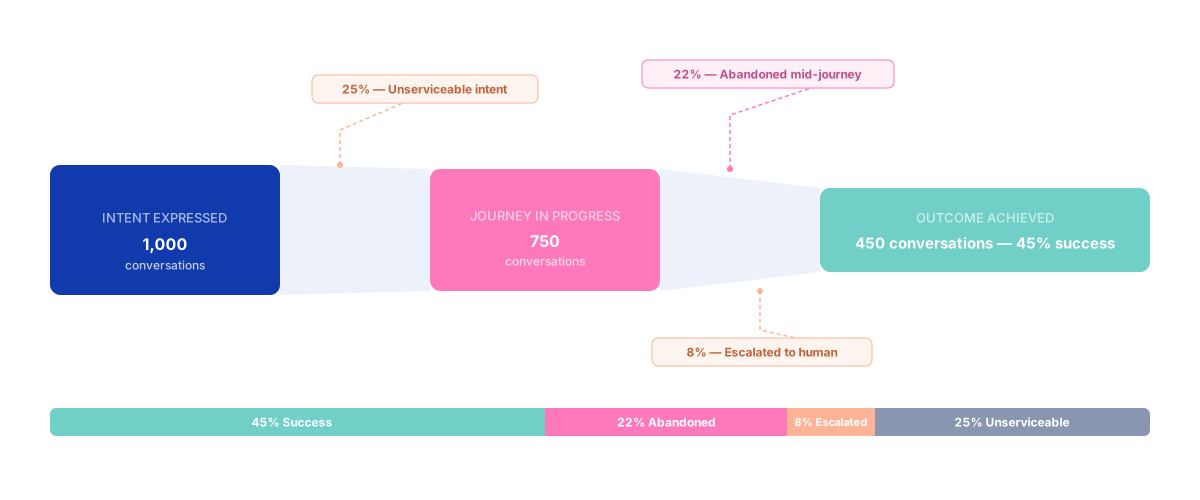
Analyzing abandonment: Why did customers leave without resolving? The journey data provides clues. Was there a frustration signal before abandonment? Did the customer retry multiple times? Was there a specific turn where the conversation broke down? Clustering abandonment conversations by pattern reveals the most common failure modes.
Understanding escalation patterns: Escalation to human agents is not inherently bad — some issues require human judgment. The question is whether escalation is happening for issues the AI should handle. If 80% of escalations are for intents the AI was designed to serve, that is a product quality issue. If 80% of escalations are for intents outside the AI's scope, that is an intent serviceability gap.
Learning from failure to improve design: Every failure pattern maps to a specific improvement. Confusion at turn 2-3 suggests better initial responses. Retries in the middle suggests better inference. Late-stage abandonment suggests better convergence. Escalation for serviceable intents suggests agent tuning.
The feedback loop from failure analysis to product improvement is the core value of outcome measurement. Without it, teams fix problems based on intuition. With it, they fix the problems that actually cause customers to fail.