
How to Measure Customer Intent in AI Products
Intent is the foundation. Learn how to capture what customers are trying to do, categorize patterns, and use intent data to make better product decisions.
Why Intent Matters
Every customer arrives with intent. They likely share similar intent to other customers, but describe it very differently. This leads to different journeys.
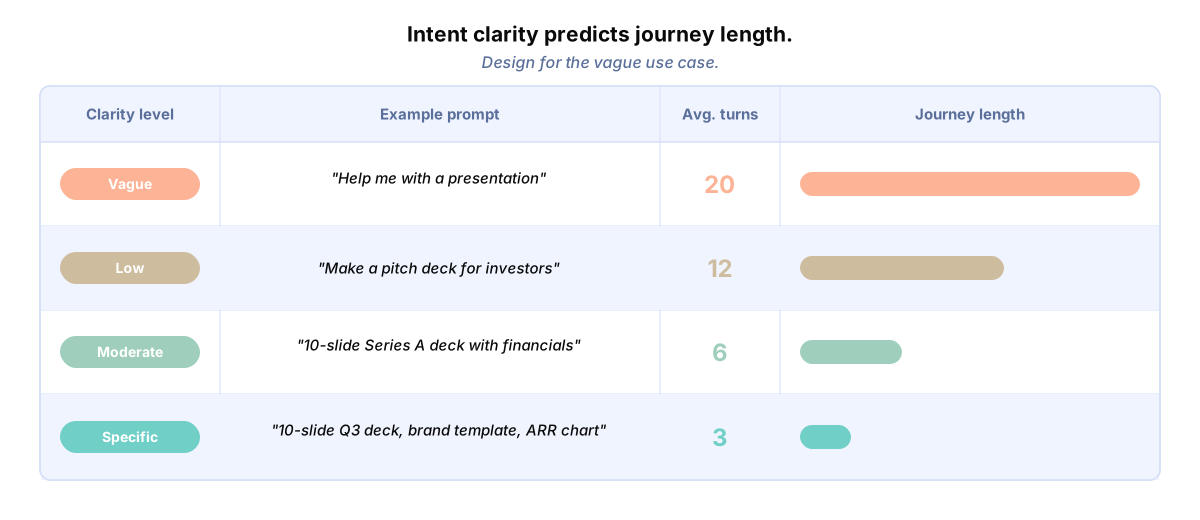
The distance between what a customer has in mind and what they type into your product determines how the rest of the experience unfolds. A customer who types "Create a 10-slide investor deck covering Q3 financials with our brand template" gives the AI everything it needs. A customer who types "help me with a presentation" does not. Both have the same goal. One will reach the outcome in 3 exchanges. The other may take 20.
Prompt quality predicts journey length. Intent clarity predicts outcome success. Without measuring intent, product teams are optimizing in the dark — unable to distinguish between product failure and user input variation.
Intent is the foundation for measuring everything else in the Experience Analytics framework. You cannot assess journey quality without knowing what the customer was trying to do. You cannot measure outcome success without knowing what success means for that customer.
Types of Customer Intent
Customer intent falls into distinct categories. Understanding these categories is the first step toward measurement.
Task completion: "Help me build a presentation," "Write this email," "Generate a report." The customer has a specific output in mind and wants the AI to produce it. This is the most common intent type for generative AI products.
Information seeking: "What is the policy on X?" "How does this feature work?" "Explain this error message." The customer wants knowledge, not an artifact. Common for AI support agents and knowledge assistants.
Problem resolution: "Fix this error," "My workflow is broken," "This output is wrong." The customer has encountered a failure and wants it resolved. Common for AI coding assistants and support agents.
Exploration: "What can you do?" "Show me some examples," "I am just trying this out." The customer does not have a specific goal yet. They are evaluating capabilities. Common for new users and trial accounts.
How to categorize for your product: Start with these four categories and refine based on your data. Most products will find that 80% of conversations fall into 3-5 intent categories specific to their domain.
Measuring Intent Clarity
Intent clarity is the specificity of the customer's initial prompt. It exists on a spectrum from vague to specific, and it directly predicts journey length and outcome likelihood.
Vague: "Help me with a presentation." Average 20 turns to outcome. The AI must ask clarifying questions, make assumptions, and iterate. The journey is long and friction-prone.
Moderate: "Make a pitch deck for investors." Average 12 turns to outcome. The AI has context about the type and audience but needs details on content, length, and style.
Specific: "Create a 10-slide Series A deck with financials and our brand template." Average 4 turns to outcome. The AI has enough context to produce a useful first draft. The journey is efficient.
Very specific: "Create a 10-slide investor deck for Q3, use our brand template, include ARR chart from the dashboard." Average 3 turns to outcome.
This correlation is consistent across AI product types. It holds for coding assistants, support agents, content generators, and design tools. Customers who provide more context get better results faster.
The product implication is significant: designing for the vague case improves outcomes for everyone. If your AI can handle vague prompts gracefully — by asking the right clarifying questions or offering structured options — it reduces friction for the majority of customers who do not arrive with perfectly formed prompts.
Intent Distribution Analysis
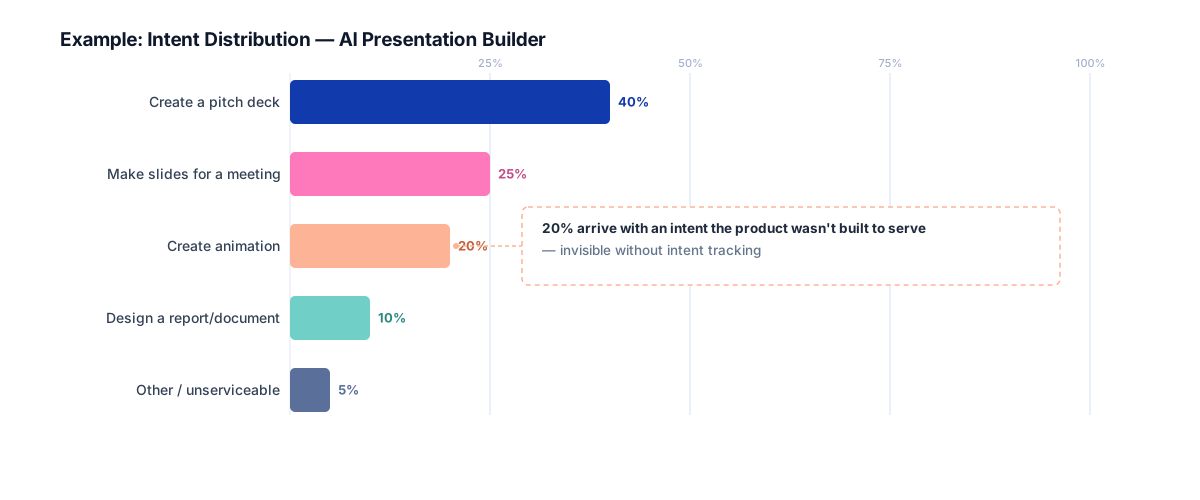
Intent distribution tells you what customers actually want from your product. It often diverges from what you designed for.
The analysis is straightforward: classify each conversation's initial intent, aggregate across all conversations, and examine the distribution. You are looking for which intents are most common, which intents the product serves well, which intents the product cannot serve, and whether the distribution matches your product's designed capabilities.
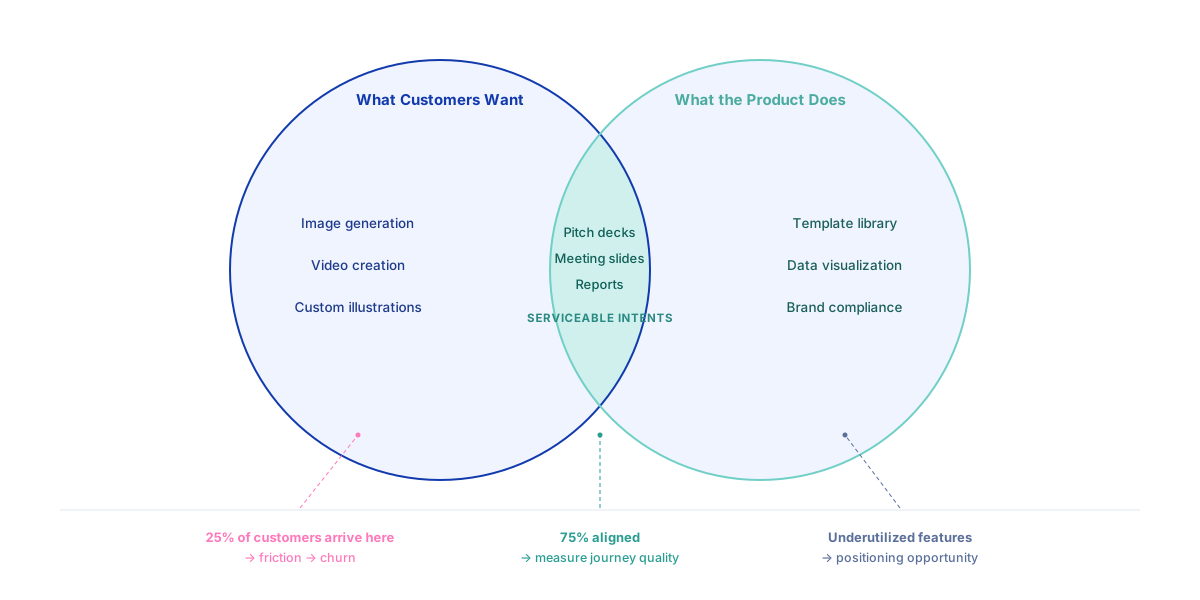
The most valuable discovery is usually the intents you did not design for. A product built for generating pitch decks may find that 20% of users arrive asking for image generation. A support agent trained on billing questions may find that 25% of users report technical bugs.
These gaps represent either product opportunities (build the capability) or positioning problems (set better expectations about what the product does). Without intent data, you are guessing.
Using Intent Data
Intent data drives three types of decisions.
Product decisions: What to optimize for. If 40% of customers arrive with task completion intent, optimize the task completion flow. If 15% arrive with intents you cannot serve, decide whether to build the capability or improve messaging to set expectations.
Onboarding improvements: Guiding customers to clear intent. If vague prompts lead to long, friction-heavy journeys, introduce structured options at the start of conversations. Offer templates, examples, or guided flows that help customers express what they want. The goal is to move customers from the vague end of the intent clarity spectrum to the specific end.
Feature prioritization: Most common intents should receive the most investment. If information seeking is 25% of your traffic, the knowledge retrieval capabilities of your AI need to be strong. If exploration is 20%, the onboarding experience matters more than you think.
Intent data also reveals customer segments. Power users arrive with specific, complex intents. New users arrive with exploratory or vague intents. At-risk users arrive with problem resolution intents. Each segment requires different product responses.