

Turning AI Analytics into Product and Business Action
Measurement without action is a dashboard nobody checks. Learn how to route experience signals to the right teams and close the feedback loop.
From Dashboards to Decisions
The trap of analytics that do not drive action is well-documented. Dashboards get built, reviewed for a week, and then ignored. The problem is not the data — it is the gap between insight and action.
Experience Analytics data is only valuable when it reaches the people who can act on it, in the tools where they work, at the time when action is possible.
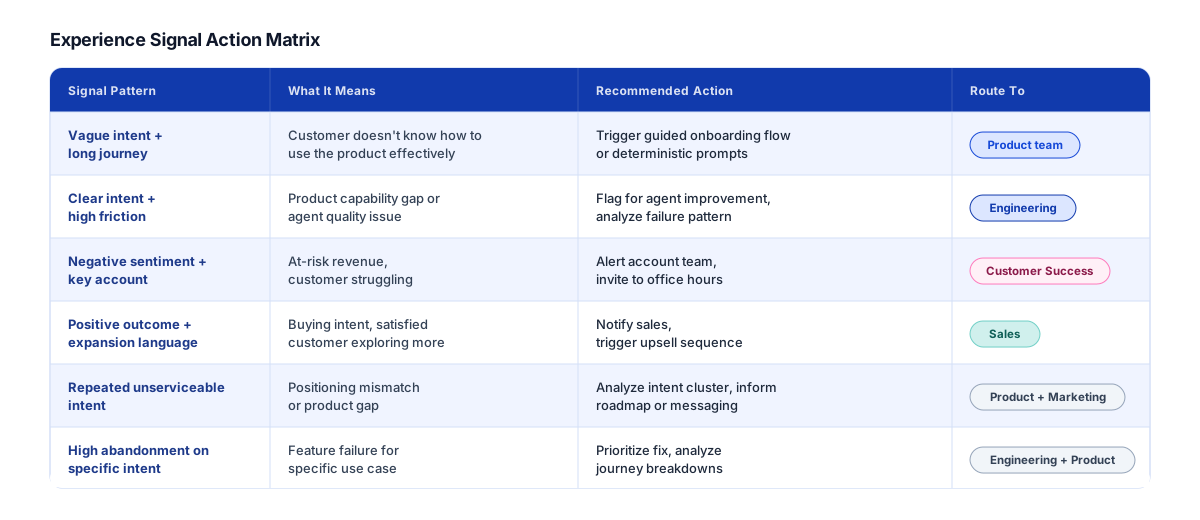
Product managers need to see intent distribution and friction patterns to prioritize improvements. Engineering needs to see specific failure patterns to fix agent behavior. Sales needs buying intent signals to time outreach. Customer Success needs churn risk signals to intervene before escalation. Leadership needs outcome-based metrics to measure AI ROI.
Each audience needs different data, delivered differently. A PM needs a dashboard. Sales needs a CRM alert. CS needs a Slack notification. Leadership needs a quarterly metric. The data source is the same. The delivery mechanism must vary.
Product Team Actions
Experience data tells product teams what to fix first.
Prioritizing improvements based on friction data: Rank friction patterns by frequency and impact. If 30% of conversations hit confusion at the initial response, that is a higher-priority fix than a friction pattern affecting 3% of conversations. Frequency multiplied by severity gives you the prioritization framework.
Redesigning journeys for common intents: If the most common intent has an average journey length of 15 turns but the theoretical minimum is 5, there is a 10-turn efficiency gap. Map those excess turns. Are they clarifications the AI should not need? Are they retries that indicate inference failure? Each excess turn has a root cause.
Building better onboarding from intent patterns: If 40% of customers arrive with vague intents that lead to long, friction-heavy journeys, the onboarding experience is failing to prepare them. Introduce guided prompts, templates, or structured options that help customers express clear intent from the start.
A/B testing experience changes: Experience Analytics provides the measurement framework for experiments. Change the AI's initial response. Measure the impact on journey length, friction signals, and outcome rate. The framework makes before-and-after comparison straightforward.
Business Team Actions
Experience data contains business signals that most teams miss because the signals are buried in conversation logs.
Buying intent signals: Customers who explore advanced features, ask about pricing, or express interest in capabilities they do not have are signaling purchase or expansion intent. These signals appear in conversations. With signal routing, they reach sales in real time.
Churn risk signals: Customers with declining sentiment trajectories, increasing friction, and decreasing outcome rates are at risk. These patterns emerge over multiple conversations. With experience data, Customer Success sees the trend before the customer escalates or cancels.
Account health visibility: Aggregate experience data by account to see which accounts are thriving and which are struggling. Combine outcome rates, sentiment trends, and journey efficiency into an account health score that CS and account managers can act on.
Connecting experience to revenue: When outcome rates correlate with retention and expansion, experience data becomes revenue data. If accounts with outcome rates above 70% renew at 95% while accounts below 40% renew at 50%, the business case for improving experience is quantified.
Automating Signal Routing
Manual review does not scale. Signal routing automates the path from detection to action.
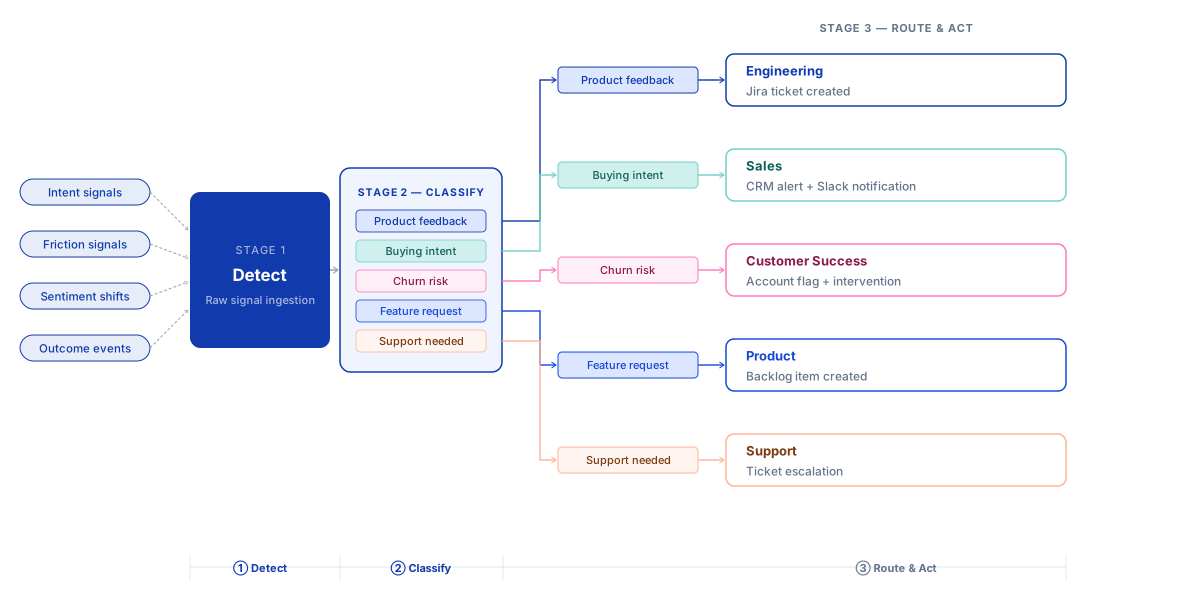
The flow: Detect signals in conversation data. Classify them by type (product feedback, buying intent, churn risk, feature request, support needed). Route to the appropriate team in the appropriate tool.
Product feedback routes to engineering via Jira or Linear. Buying intent routes to sales via CRM alert and Slack. Churn risk routes to Customer Success via account flag and Slack. Feature requests route to product backlog. Support issues route to the ticketing system.
Real-time alerts for high-value signals: Not all signals require immediate action. But some do. A key account showing frustration signals in a conversation happening right now is a signal that warrants real-time notification. A new enterprise trial user expressing buying intent is a signal sales should see within minutes, not days.
Building workflows that scale: Start with the highest-value signal types and the simplest routing. Churn risk to Slack is a good first workflow. Buying intent to CRM is a good second. Expand as you prove the value of each routing path.
Closing the Loop
The final step is measuring the impact of changes.
When you fix a friction pattern identified by experience data, measure whether friction decreases. When you improve onboarding based on intent data, measure whether intent clarity improves. When you tune agent behavior based on failure analysis, measure whether outcome rates increase.
This creates a feedback loop: Measure experience. Identify patterns. Take action. Measure the impact. The loop compounds. Each iteration improves the experience. Improved experience improves outcomes. Improved outcomes improve retention, expansion, and revenue.
Building a culture of experience optimization requires this loop to be visible. When the team can see that a specific change reduced average journey length by 4 turns and increased outcome rate by 12 percentage points, the value of experience measurement is self-evident.
The goal is not a perfect analytics setup on day one. The goal is a loop that produces visible improvements and builds organizational confidence in experience-driven decisions.